 Chess Red
Endgames / Pawn races
Count the race
Can the black king catch the b-pawn? You can answer without calculating every move. Start by drawing a square.
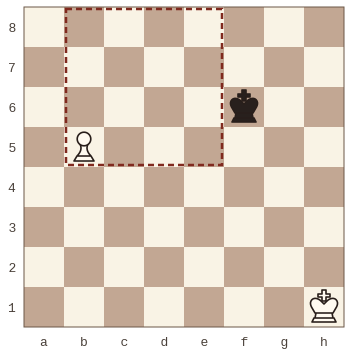
Draw the pawn’s square
The pawn needs three moves: b6, b7, and b8. Trace three steps from b5 to b8. Then trace three steps sideways from b5 toward the black king, to e5.
Complete the square at e8. Black’s king on f6 is one file outside it. The white king on h1 is too far away to help.
Let White move first
Push the pawn to b6. It now needs only two moves. Its new square ends on the d-file. Even a diagonal step to e7 leaves Black one file short.
1. b6 Ke7 2. b7 Kd7 3. b8=Q
The queen is safe on b8. Notice why the king ran diagonally: a diagonal move gains both a rank and a file, but it still takes one turn.
Give Black the first move
Reset the board. This time Black moves first. Which file must the king reach now?
Check your answer
The e-file. Play the king from f6 to e6. After b6, play Kd6. After b7, play Kc7. If White promotes on b8, the king captures the new piece.
The white king cannot protect b8 from h1. With both kings alone, the game is a draw.
Know when to count again
Use the square for a free pawn with a clear path. If it can still advance two squares, count that first push as one move. If another piece guards its path, check the actual moves.