 Chess Red
Endgames / Underpromotion
Leave the king a square
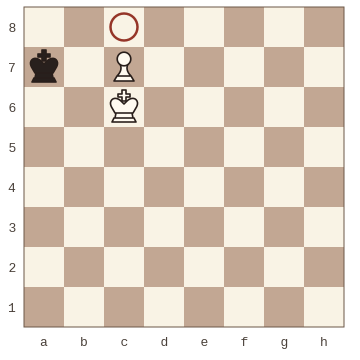
The strongest piece is not always the right piece. Here a rook wins because it controls fewer squares than a queen.
Test the obvious move
Imagine a white queen on c8. Does it check the king on a7? No. Now count the black king’s five possible destinations.
- a8 and b8: the queen covers the eighth rank.
- b7 and b6: the white king covers both squares from c6.
- a6: the queen covers this last square along the diagonal from c8 through b7.
Black has no other piece to move. The king is not in check, but every move is illegal. That is stalemate, so the game ends in a draw.
Take away the diagonal
Promote to a rook instead. The rook still controls the eighth rank, but it does not attack a6. Black has exactly one legal reply.
1. c8=R Ka6 2. Ra8#
On a8, the rook gives check down the a-file. The white king on c6 guards b5, b6, and b7. There is no escape.
Try the position again
Without moving the pieces, name the one square that changes the result after promotion.
Check your answer
a6. A queen on c8 attacks it; a rook on c8 does not. Black must step there before White can deliver mate.